Showing posts with label Science. Show all posts

Friday, September 26, 2008

LHC Shut Down Until Spring 2009

Full-power operation of the Large Hadron Collider (LHC) won't happen until early spring 2009, after an electrical glitch sparked a large helium leak inside the machine's tunnels.

Although repairs should take just about two months, the collider needs to be shut down in the winter to save costs. Officials with the European Organization for Nuclear Research (CERN) therefore decided not to restart the particle accelerator until next year.
080923-hadron-collider_big

"Coming immediately after the very successful start of LHC operation on 10 September, this is undoubtedly a psychological blow," CERN Director General Robert Aymar said in a press release.

"Nevertheless, the success of the LHC's first operation with beam is testimony to years of painstaking preparation and the skill of the teams involved in building and running CERN's accelerator complex.

"I have no doubt that we will overcome this setback with the same degree of rigor and application."

"Last Hurdle"

Twenty years in the making, the world's largest atom smasher, built near Geneva, Switzerland, was designed to investigate dark matter, the big bang, and other mysteries of the early universe. (Interactive: understanding the God particle.)

Operators hurled the first beam of low-energy particles through the collider's 17-mile (27-kilometer) underground track just over a week ago.

The successful test had officials hopeful that they could start smashing opposing beams of particles together in as little as two week's time.

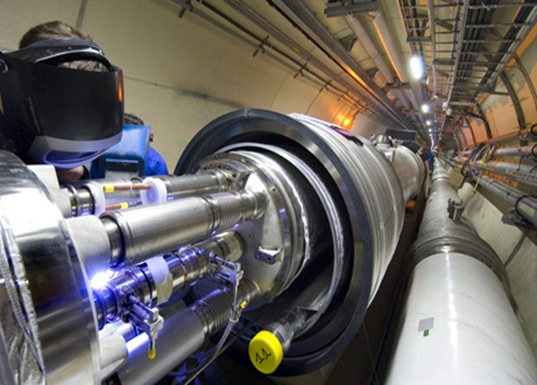
But during a routine test on September 19, an electrical link failed between two of the machine's massive 30-ton superconducting magnets, which guide speeding particles through the track.

"What we know indicates there was a faulty connection between two cables joining two magnets together that warmed up to the point of melting and that resulted in helium being leaked into the tunnel," CERN spokesperson James Gillies told National Geographic News.

No one was hurt during the malfunction, and the problem has been confined to a roughly two-mile (three-kilometer) swath of the track.

"This was actually the final electrical test of the final electrical circuit for qualification for running at high energy," Gillies said.

"This would have been the last hurdle."

"Teething Troubles"

The delay is due to the fact that the collider's operating temperature inside the track is -456.3 degrees Fahrenheit (-271.3 degrees Celsius).

For engineers to fix the problem, the section has to be warmed up, repaired, and cooled back down, a process known as a thermal cycle.

The thermal cycle for the LHC is about two months.

"The thing that went wrong [at the LHC] is not such a big deal," said Mike Harrison, a high-energy physicist at Brookhaven National Laboratories in Upton, New York.

"The actual fix will be a day or two probably," he said. "The problem is you have to warm it up and cool it down again. That's what takes up time."

Harrison added that this kind of delay is just part of the process of getting a particle accelerator ready for business.

He was involved in the design and fabrication of Brookhaven's Relativistic Heavy Ion Collider (RHIC), a smaller version of the LHC that's been in operation since 2000.

"You expect to have probably a couple of thermal cycles as you go through the commissioning process" of a particle accelerator, Harrison said.

CERN's Gillies agreed that "teething troubles" are inevitable with a machine as complicated as the LHC, and that other particle accelerators have faced similar problems.

"It's one of those things you have to be ready for when you start to operate a machine like this," he said.

"It's just more time-consuming with a superconducting machine, where you have a warm-up and a cool-down phase involved with any repair."

And also check:

End of the World - 10th Sep 2008

Wednesday, September 10, 2008

End Of The World - Sep 10th 2008...!

LHC_Beam

Three decades after its conception, half as long in construction, and several years behind schedule, the switch will finally be flicked on the Large Hadron Collider (LHC) at CERN in Geneva, on 10 September.

Once up and running, the $10 billion machine will be world's most powerful particle collider, smashing protons into each other at an energy seven times higher than that of the Tevatron collider in the US. Physicists will then be in uncharted territory, hunting for new particles that could overturn their theories about nature's most fundamental laws.

The main reason for announcing the start-up date almost five weeks in advance is to give the thousands of physicists working on the LHC's four giant particle detectors time to prepare. "This will focus the minds of all concerned to respect the date announced," LHC project leader Lyn Evans told New Scientist.

It has taken six months and hundreds of tonnes of scarce liquid helium just to cool the superconducting magnets that will bend the protons around the 27-kilometer-ring to their operating temperature. Once all 1600 are sitting comfortably at -271 °Celsius, in the next week or two, around 1400 electrical tests will be carried out to make sure that everything is wired up correctly.

This weekend, the operations team will test the injection of protons into one of the LHC ring's eight sectors. This involves using a pulsed magnet to "kick" bunches of protons out of a smaller accelerator called SPS and down a 'transfer line' into the LHC. The procedure is tricky because the pulses and bunches must coincide to within a fraction of a millisecond.

Come 10 September, when the warren of caverns and tunnels has been checked out and sealed off – using high-security, iris-scanning locks, the first protons will be whipped up to nearly the speed of light through a chain of smaller accelerators on the CERN site. Then they will be injected into one of the LHC's two adjacent beam-pipes at an energy of 0.45 trillion electron volts (TeV).

Course correction
The protons might get just a few tens of metres into their 27-km circuit before veering off course and being lost, so the operations team will adjust the magnets and try again with a fresh beam until they have systematically threaded the protons around the entire machine. That could take from a few hours to a few days with a crew working around the clock. Then, the team will have to do the same for the beam in the other direction.
The next challenge will be to get the beams in a stable orbit for several hours at a time. Only then can CERN contemplate ramping up the energy to 5 TeV and finally bringing the counter-rotating beams head on at a collision energy of 10 TeV.
If luck is on their side, that should take place around the time of the official LHC inauguration on 21 October. In early 2009, the protons are set to collide at the full energy of 14 TeV.

Mystery of mass
Discoveries will come much later still. Although some exotic new particles, if they exist, could reveal their presence when the beams collide this year, it will likely take a year for researchers on the LHC's four experiments to understand their cathedral-scale detectors well enough to make a discovery.
Finding the Higgs boson, which would solve the mystery of where mass comes from, could take two to three years.
The LHC schedule has suffered several setbacks, including a delay in fitting the cryogenic plumbing for the liquid helium and a shorter interruption last March due to faulty magnets.

But CERN is now on the home stretch. "It's been a long haul," says Evans. "We're finishing a marathon with a sprint."

Basically they're going to smash some particles into each other at near the speed of light to see if it would create "The Big Bang" again!!

Its going to possibly cause a black hole or anti-matter which will swallow the earth.

An Armageddon..! i can't believe this crap!

And also check:

Testing the Big Bang Theory - For Real

Testing The Big Bang Theory - For Real

Finally the day came, 10th September 2008 the big day in everyone's life.

300 feet below Meyrin Switzerland, scientist are set to turn on the one most expensive machine ever built.  Meet the world’s largest particle accelerator named The Large Hadron Collider.

15cern_xlarge1

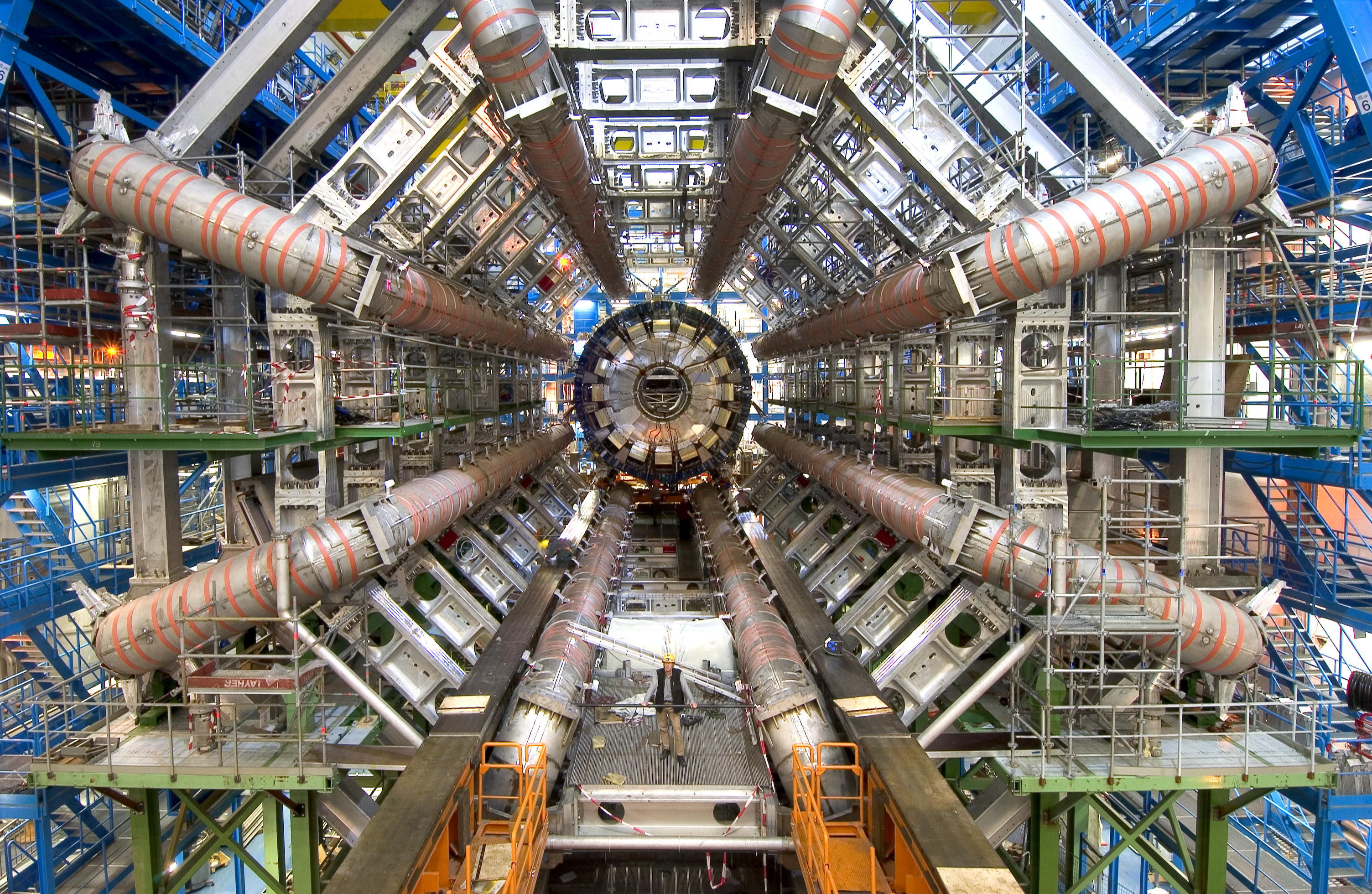
At CERN, the Large Hadron Collider could recreate conditions that last prevailed when the universe was less than a trillionth of a second old. Above is one of the collider's massive particle detectors, called the Compact Muon Solenoid.

The Large Hadron Collider was built to look at how the Universe was created by analyzing particle collisions.  This has quit a lot of people a little nervous since no one knows what could happen if things go wrong.  Either way it’s still a very interesting project which deserves  more reading.  If you are interested, click on this link for the full New York Times story.

atlas_cern

0503019H

This picture shows how big the tunnel is, 17 miles in which scientist will attempt to circulate a beam of protons...

T047577A

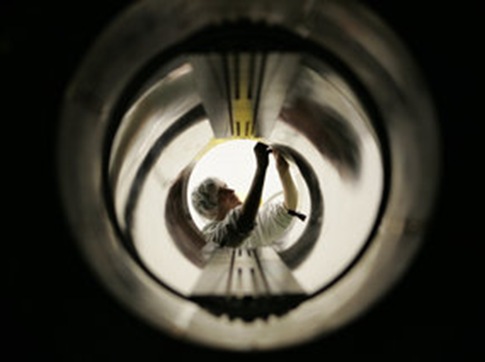
Scientists and technicians working day and night, monitoring each and everything twice and thrice to making sure they do not put an end to our Universe by trying to figure out how it started...

hadron-collider-400

080215-large hadron collider-717p.jpg

Scientists

A technician assembles the tracker of the magnet core of the Compact Muon Solenoid, a 1920-tonne element at CERN, March 22, 2007. CMS is part of five experiments which will study what happens when beams of particles collide in the 27 km-long underground Large Hadron Collider

r239050_966648

The “Big Bang” is a theory first postulated by physicist and astronomer Georges LemaĆ®tre based on Einstein’s theory of general relativity to cosmology. It states that the universe was created approximately 15 billion years ago when it was little more than a tightly woven packet of small atomic mass that exploded and has been expanding from its primordial hot and dense initial condition to the continous expanse of universe that we know today.

CERN will try to recreate a mini-version of the “Big Bang” deep underground by using its Large Hadron Collider (LHC) particle smasher. Early preliminary testing has been successful and now the agency is ready test or “re-stage” what science believe was the actual birth of our universe, only on a much, much smaller scale.

LHC-main

Evans and his LHC team will send a full particle beam all the way around the collider pipe in one direction before sending beams in both directions, traveling at the speed of light, and smashing them together later in the year. The resulting collision will be monitored on computers at CERN and laboratories around the world by scientists looking for the ultimate proof to the theory, a, or the, particle (called “Higgs boson”)that made life possible. The Higgs boson is thought to be the particle of glue that holds all matter together, thus creating the universe and all life in it.

The particle is named after 79-year old Scottish physicist Peter Higgs, who will be on hand in Switzerland for the experiment. He believes that his “Higgs boson” should appear quite quickly once the two beams collide. Others are not so sure.

For more info:

LHC - Official site

Large Hadron Collider - Wikipedia entry

LHC commissioning with beam CERN's website for commissioning the LHC

Boston-LHC More pictures

And also check:

End of the world - Sep 10th 2008!

Popcorn - Fresh Every Day